




A love letter to the cinema experience
The directors of the San Sebastian and Bogotá festivals, José Luis Rebordinos and Andrés Bayona, talked about the organisation of film festivals that inspire audiences and the industry.
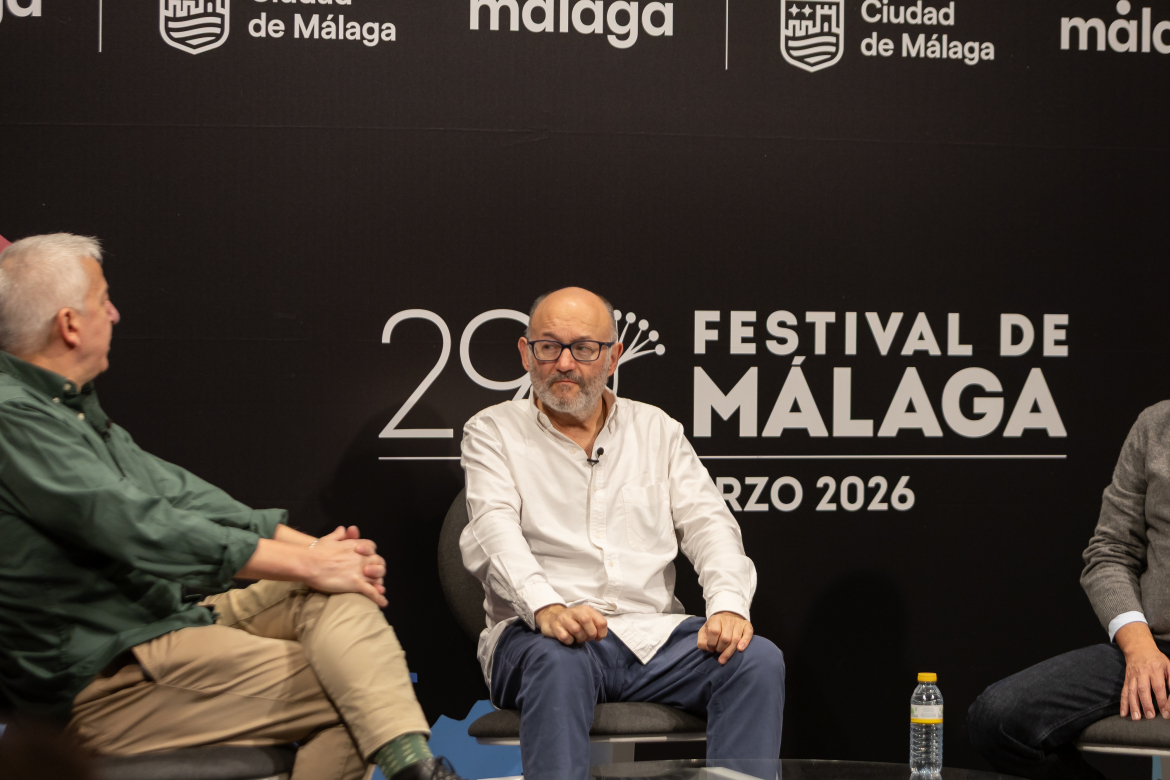
In the talk organised by DAMA as part of the Festival de Málaga, José Luis Rebordinos, the director of the Festival de San Sebastián since 2011, and previously on the Steering Committee, shared his thoughts with Andrés Bayona, director of the Bogotá International Film Festival, as they analysed the essence of the film experience, which continues to arouse the same curiosity as it did when it first began.
In this transatlantic dialogue, the two directors discussed the urgent need for festivals as beacons of resistance in a digital environment with so much content and so many different voices. In contrast to the solitary algorithm, the presence of festivals was vindicated as the space where cinema regains its character as a collective event, demonstrating that human and industry contact are what keep the screen alive.
The unique style of each festival
Maintaining its unique essence was the great challenge for the BIFF, in a city of 10 million inhabitants where 75% consume audiovisual content via mobile phones. Faced with this revealing data, he opted to commission distinctive programming that was faithful to his brand. It has been hard work, said Bayona, but this rigour has earned him a reputation that now has production companies and distributors competing to premiere their films in his space.
Having said that, Rebordinos pointed out that absolute purity is impossible in the face of constant pressure from production companies to showcase their titles. For the director, although there are concessions that must be made, the key lies in setting red lines that protect the artistic identity of the competition.
The democratisation of the audiovisual sector
The directors agreed that women's access to technical and production roles is moving steadily towards a future where there is full integration, while sustainability is moving at a slower pace. However, they placed the real divide in social class.
The director of the Basque festival said that he found the film Ciudad sin sueño (City without a Dream) very interesting, but that it is narrated from an external perspective, rather than from the point of view of the main characters themselves. Both lamented that the high cost of film schools is silencing local stories that never see the light of day due to lack of resources and lack of access to educational institutions.
To try to combat this silence, they highlighted the role of talent labs and specific sections that give new voices a voice. Initiatives such as the Festival de San Sebastián's Ikusmira Berriak are already bearing fruit with award-winning projects such as La misteriosa mirada del flamenco (The Mysterious Gaze of Flamenco) and Estrany Riu (Strange River).
In this regard, the directors positively valued programmes such as Málaga Talent, whose emerging creators, present at the talk, are the new lifeblood that cinema needs.
The Festival de Málaga, at the heart of the talk
The talk took place in the Rossini Hall of the Cervantes Theatre, in the heart of the Festival de Málaga, and was the ideal setting to defend the health of alliances.
Bayona applauded the fluid circulation of talent and industry between the two countries, pointing to Malaga as an absolute benchmark on the American continent. For his part, Rebordinos praised Juan Antonio Vigar' s management and his growing international impact, materialised in specific collaborations such as MASS , the Spanish film season that both festivals present jointly in the capitals of Argentina and Uruguay.
This harmony shows that far from being an obstacle, competition acts as a driving force that strengthens Spanish cinema, and that communication between the two gives rise to projects that broaden the stories’ voice.
The future of festivals
The business model has mutated and the exclusivity of a premiere at Cannes or Venice is no longer the only path to success. Rebordinos pointed out that production companies today seek to maximise their reach through a presence at different festivals, using each one as a strategic loudspeaker for their productions.
Rebordinos has witnessed this entire evolution throughout his career in San Sebastian, which comes to an end this year. The Basque spoke frankly: "You start to lose energy, and I think 15 years is too long. My team and I are here to bring about change, but now we need a different vision for the future, hopefully from someone younger.
Having said that, he assured that he will continue to support filmmakers to make a name for themselves in the industry, helping projects that interest him and writing about his two passions: the seventh art and cooking.
This is not The end, it is To be continued.